






















THE EVOLVED EDIT
Are Metal iPhone Cases Good? Signal, MagSafe & Protection
Metal iPhone cases can work well when the design preserves antenna and charging paths. Learn how to check signal, MagSafe, protection and exact model fit.

The short answer
A metal iPhone case can be a good choice, but the word “metal” is not enough to judge it. The best designs use metal selectively, preserve the phone’s charging path, fit the exact model and include softer phone-facing materials. A poorly placed metal layer or an added steel mounting plate can interfere with wireless charging, while a case that covers antenna areas may affect reception.
Before buying, separate four questions: Does it attach magnetically? Does it actually charge wirelessly? What charging speed does the complete setup support? Has the exact product been tested or certified for the claim being made?
First, find out how much of the case is actually metal
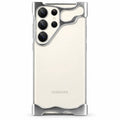
“Metal case” can describe very different products. Some use a metal perimeter with a polycarbonate back. Others are open-back bumpers, while some plastic cases only have a metallic-looking finish. These constructions do not behave the same way.
| Construction | What it can offer | What to verify |
|---|---|---|
| Metal frame with a nonmetal back | A structured edge and a clear charging zone | Soft inner contact points, antenna clearance and magnetic-ring placement |
| Open metal bumper | Minimal coverage that leaves the phone visible | Which surfaces remain exposed and whether accessories sit flat |
| Full metal back or shell | A continuous metal appearance | Wireless-charging support, heat, weight and reception with the exact phone |
| Plastic shell with metallic finish | The look of metal with a lighter construction | The actual material, corner protection and durability of the finish |
Apple’s accessory guidance says cases should complement a device without interfering with its operation, and tells accessory makers to follow the design guidelines and test prototypes. That is why a broad material label is less useful than the exact construction and model-specific fit. Apple: designing accessories.
Can a metal iPhone case affect cellular, Wi-Fi or GPS signal?
It can, but the result depends on where the conductive material sits and how much of the phone it covers. Cellular, Wi-Fi, Bluetooth and GPS use different radios and antenna paths, so one feature working does not prove that every other wireless function is unaffected.
There is no honest universal promise that every metal case has zero signal effect. The phone model, case geometry, band in use, network conditions and the way you hold the phone all matter. A hybrid frame with large nonmetal sections is not the same as wrapping the device in a continuous metal shell.
How to check reception without guessing
- Choose a familiar place where reception is stable but not unusually strong.
- Make a call and load the same page or video with the case removed.
- Fit the case, wait for the phone to reconnect and repeat the same actions in the same position.
- Remove any separate steel mounting plate, wallet or grip and test again.
- If a problem appears repeatedly only with the case installed, stop using that combination and contact the case maker.
A single change in the number of signal bars is not a controlled test. Repeat the comparison, because network load and hand position can change from one moment to the next.
Will MagSafe and wireless charging work through a metal case?
A purpose-built hybrid case can support magnetic charging when its back, magnetic ring and thickness are designed around the phone’s charging area. A random metal plate placed between the phone and charger is a different situation.
Apple says wireless charging uses magnetic induction and warns that magnetic mounts, magnetic cases or other objects between the iPhone and charger may reduce performance. If an iPhone charges slowly or not at all with a thick, metal or battery case, Apple recommends trying again after removing the case. Apple: how to wirelessly charge iPhone.
Keep these terms separate:
- Magnetic attachment: the phone or case sticks to the accessory.
- Wireless-charging compatibility: power transfers through that exact case and charger combination.
- Charging speed: the phone, charger, adapter, cable, alignment, temperature and battery state determine the delivered power.
- Certification: a recognized certification applies to a specific product model; a ring graphic or the word “magnetic” does not establish it.
The Wireless Power Consortium says Qi-certified products are tested for safety and interoperability, and its public database can be used to check a specific certified model. Wireless Power Consortium: Qi certification.
For step-by-step troubleshooting, use our guide to wireless charging through a phone case.
Is a metal case more protective than silicone or plastic?
Not automatically. A rigid outer frame can feel solid, but impact protection depends on the complete structure: corner design, raised screen and camera edges, inner cushioning, fit and how energy is managed during a drop. Metal alone is not a drop-test result.
Check for specific construction details instead of relying on words such as “indestructible” or “military grade.” If a seller gives a drop height or certification, look for the test standard, conditions and result for the exact case.
Metal also brings practical tradeoffs. It can add weight, hard finishes can show dents or scratches, and a rigid edge needs a phone-facing layer that prevents hard material from rubbing directly against the device. Silicone usually feels softer and grippier; polycarbonate can reduce weight; an open bumper shows more of the phone but leaves more surface exposed.
Compare the options in our clear, silicone, leather-finish and metal case guide.
What should iPhone 18 Pro and Pro Max buyers check?
Apple announced iPhone 18 Pro and iPhone 18 Pro Max on September 9, 2026, in Black, Silver, Glacier and Burgundy. Similar colors do not make cases interchangeable: every case still needs to match the exact model’s body, camera platform, controls, ports and charging alignment. Apple: iPhone 18 Pro announcement.
Do not choose a case from the product photo alone. Confirm the selected variant says iPhone 18 Pro or iPhone 18 Pro Max, then inspect the camera opening and button positions before installation. Our iPhone 18 case buying guide covers model fit and protection styles in more detail.
A current Evolved metal-frame option
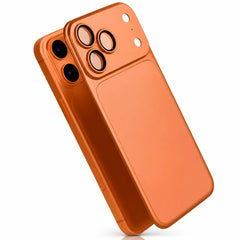
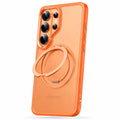
The current MagCase Metal listing describes an aluminum frame, rigid polycarbonate back, soft inner layer, raised screen and camera edges and built-in magnetic alignment. Those are construction details—not independent proof that every network, charger or accessory will behave identically.
Select the exact supported iPhone variant, then test the complete combination you plan to use. You can also browse the iPhone 18 case collection to compare fuller shells with more minimal bumper designs.
Frequently asked questions
Do metal phone cases block 5G?
Not every metal case blocks 5G, but conductive material placed over antenna areas can affect reception. The effect depends on the phone, case design, band and local coverage. Look for model-specific engineering and testing rather than a blanket claim.
Can a metal case work with MagSafe?
Yes, a purpose-built hybrid metal case can support magnetic alignment and wireless charging when its charging area is designed correctly. Magnetic attachment alone does not prove a particular charging speed or certification.
Should I remove a metal case to charge my iPhone?
A case designed for your charging system should normally stay on. If charging is slow, intermittent or absent, Apple recommends removing a thick, metal or battery case as a troubleshooting step.
Is a metal case better than a silicone case?
Neither is universally better. Metal-frame construction suits shoppers who want a structured feel and finish; silicone suits people who prioritize a soft, grippy surface. Fit, corners, raised edges, lining and verified compatibility matter more than the material name alone.